Ramana Maharshi
Also known as Bhagavan Sri Ramana Maharshi, Venkataraman Iyer, The Sage of Arunachala
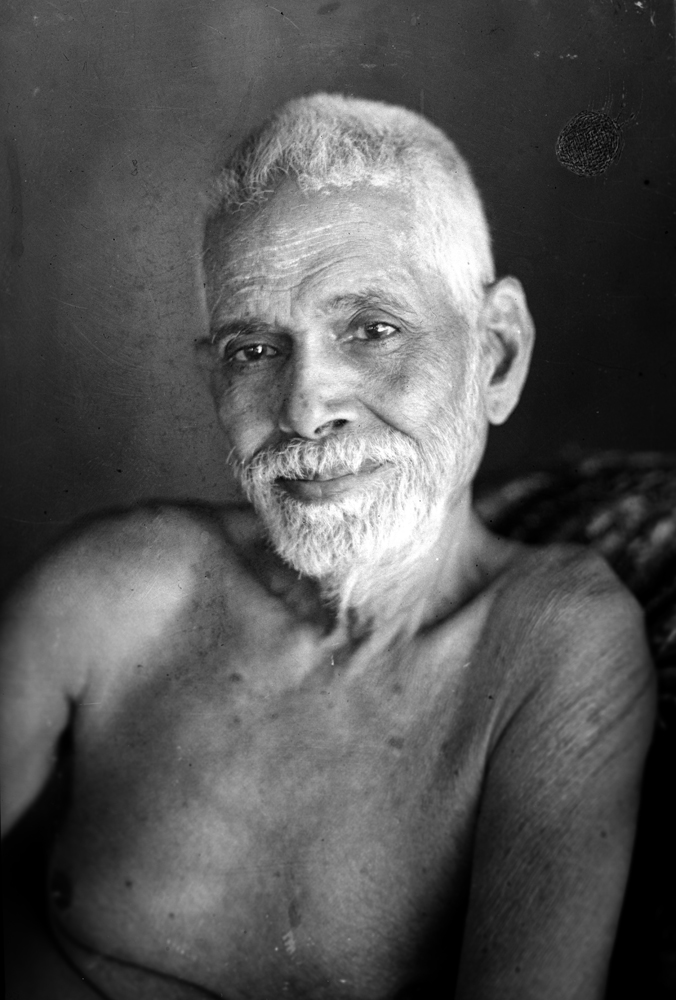
Ramana Maharshi was a Tamil sage who came to Arunachala hill at sixteen and stayed there for the rest of his life, teaching self-enquiry - the inward question Who am I - as the direct way to know the self. He gave most of his guidance in silence, and the ashram that grew around him, Sri Ramanasramam at Tiruvannamalai, is still where pilgrims go.
- Born Venkataraman Iyer on 30 December 1879 at Tiruchuli, a village near Madurai
- Came to Arunachala hill in 1896, at sixteen, after a spontaneous death-experience
- Lived in the hill's caves and shrines, Virupaksha Cave among them, before any ashram existed
- Sri Ramanasramam grew from 1922 around the samadhi of his mother Alagammal
- His mahasamadhi was on 14 April 1950; the samadhi hall is at the centre of the ashram
- Paul Brunton's A Search in Secret India (1931) carried his teaching to the West
Life and teaching
Ramana Maharshi was born Venkataraman Iyer on 30 December 1879 at Tiruchuli, a village near Madurai in Tamil Nadu, the second of four children in a Brahmin family.
In July 1896, at sixteen, he had a spontaneous experience of his own death in which he became aware of a current he recognised as his real self - the event he later called his awakening. Six weeks later he left his uncle's home in Madurai and travelled to Arunachala hill at Tiruvannamalai, where he stayed for the rest of his life.
Years on the hill
For the next decades he lived in the caves and shrines of Arunachala - Virupaksha Cave and later Skandashram among them - with almost nothing of his own and very little speech. Visitors began to come for his darshan, and many of them stayed on.
In May 1922 his mother Alagammal died. That December he moved down to the foot of the hill beside her samadhi, and the ashram that carries his name grew there: a first thatched hut, the Old Hall in 1928, and the temple inside the campus built between 1939 and 1949 by Vaidyanatha Sthapati, a descendant of the architect of the Brihadeeswara temple at Thanjavur. He lived in the Old Hall until 1949.
His teaching
Ramana Maharshi taught self-enquiry: to turn attention inward and hold the question Who am I, so that the false identification with body and mind falls away and what remains is seen to be the self. He accepted devotion and complete surrender just as fully, and said the mind is quietened by asking where the thinker comes from. Most of the guidance he gave was in silence - visitors sat in his presence and received instruction without a word.
They say that I am going away, but where can I go? I am here.
Bhagavan Sri Ramana Maharshi, as quoted on the ashram's own website
The place today
Sri Ramanasramam keeps his samadhi hall at its centre, with meditation halls, a library and archives of his writings, a bookstore, a Vedpathshala and a goshala. Devotees from all over the world still come for the daily chanting and pujas, and satsang centres in many countries keep the teaching going.
Places connected with Ramana Maharshi
- Sri Ramanasramam His ashram at the foot of Arunachala, with the samadhi hall
Looking for a room? Places to stay in Tiruvannamalai on Vedic Safar, or the spot pages above for what is near each place.
Questions about Ramana Maharshi
Who was Ramana Maharshi?
What is self-enquiry?
Where is Ramana Maharshi's samadhi?
What is his connection with Arunachala?
Can I visit and stay at Sri Ramanasramam?
Sources
- Sri Ramanasramam - the ashram's own website
- Ramana Maharshi - Wikipedia
- Sri Ramana Ashram - Wikipedia
Compiled from the sources above - dates and places as they are recorded there. Something out of date? Tell us and we will correct it.